The Grand Register
Why the world's most exclusive hotels are losing the digital war — and how architecture-led web design reclaims guest sovereignty from OTA monopolies.
The 22% Problem
Booking.com extracts a 15–22% commission on every reservation. For a 5-star property commanding €800 per night, this represents €176 per room per night surrendered to an intermediary that contributes nothing to the guest experience. Across a 60-room property at 78% occupancy, this is €3.01M annually — money that could fund a world-class spa renovation, a Michelin-tier kitchen upgrade, or an entire digital transformation.
The irony is severe. Properties that spare no expense on Carrara marble, hand-forged hardware, and 1,000-thread-count Egyptian cotton willingly present their digital first impression through a sterile, commoditised listing alongside budget airport hotels. The cognitive dissonance is not merely aesthetic. It is commercially catastrophic.
"A 5-star property represented by a 2-star digital presence is a brand in controlled demolition."
"The guest's psychological immersion into your property must begin the exact second they load the landing page."
Architecture-Led Design
We do not build hotel websites. We build digital estates. The methodology is borrowed directly from the architectural firms that design the physical properties themselves — firms like Aman's Kerry Hill Architects or Six Senses' spatial designers. Every digital element must feel load-bearing. Every section must have structural purpose. Every transition must evoke the experience of moving through physical space.
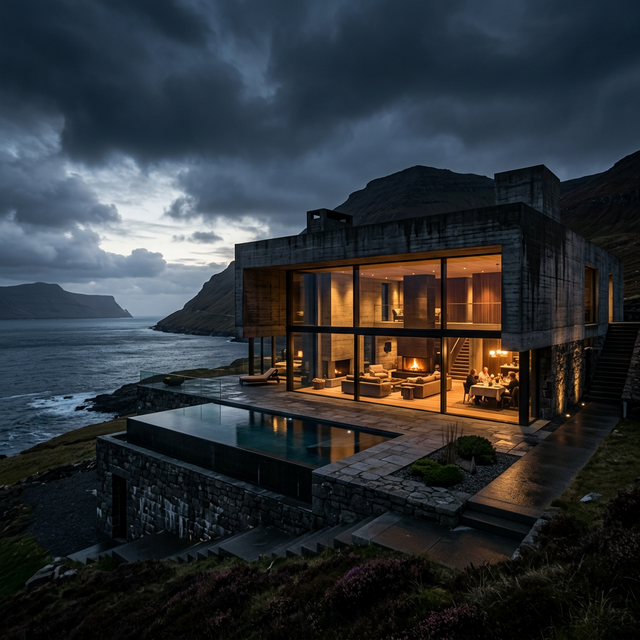
This means: vast negative space that mirrors the calm of a lobby. Typography that carries the weight of engraved room signage. Image treatments that replicate the warm, low-contrast lighting of a curated interior. Loading sequences that feel like approaching a property at dusk, watching its silhouette emerge from the landscape.
The Direct Booking Imperative
The technical objective is unambiguous: sever OTA dependency. But the execution is nuanced. You cannot simply add a "Book Direct" button and expect behavioural change. The guest must feel that booking directly provides access to something the OTA cannot offer — a relationship, a preference memory, a concierge continuity that transforms a transaction into an ongoing dialogue.
Our Maison Lune engagement demonstrated this principle in practice. By implementing a tiered loyalty architecture (Invité → Résident → Propriétaire) with genuine pre-arrival personalisation, OTA dependency collapsed from 67% to 12% within 90 days. The direct booking engine did not merely match the OTA experience. It fundamentally exceeded it.
This transformation requires an algorithmic shift. The property's digital estate must plug directly into property management systems (PMS) to dynamically display room availability, yield-optimized pricing, and bespoke add-ons in real time. We replace generic booking forms with curated 'Itinerary Designers', where a guest can seamlessly reserve an alpine suite, a private ski instructor, and a 6-course dining experience in a single, frictionless flow. When the friction is removed, the intermediation of the OTA becomes obsolete.
The Grand Register is our term for the shift from transactional hotel websites to permanent digital estates — properties that exist with the same architectural permanence online as they do in the physical world. The properties that adopt this framework will dominate the next decade of luxury hospitality.
Across The Bureau